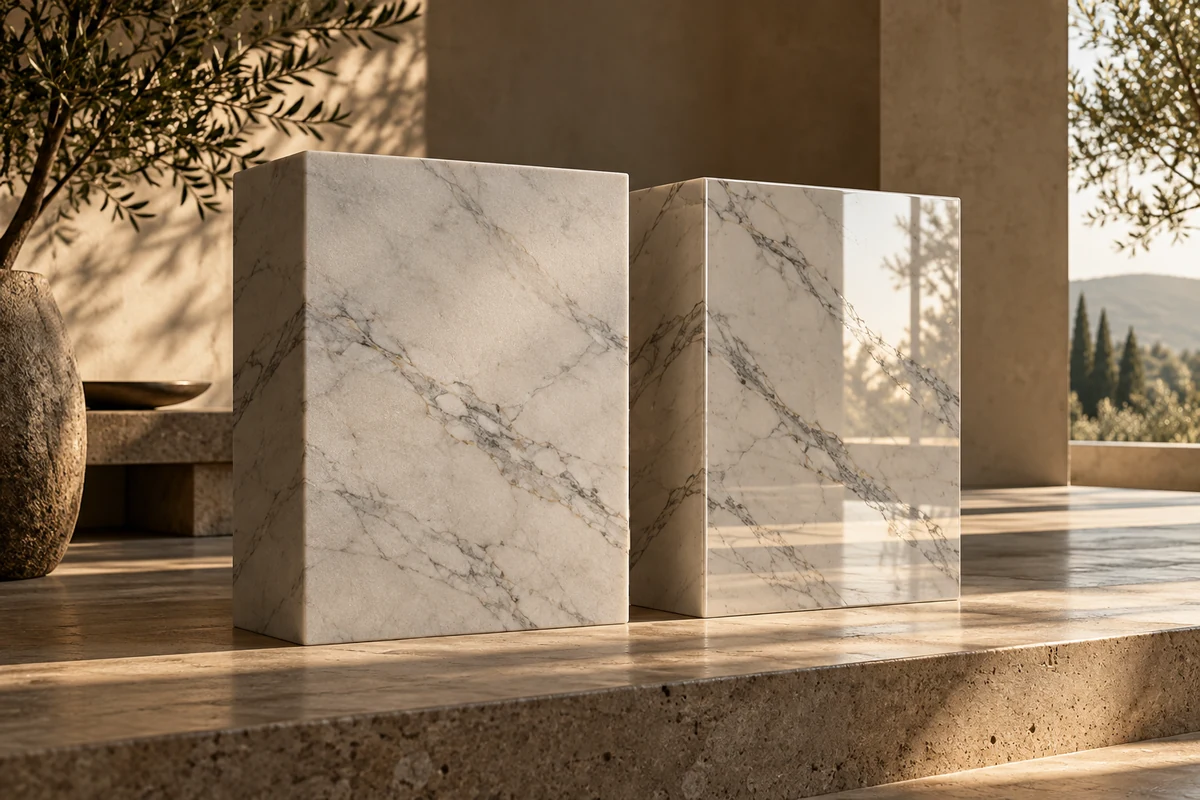
Honed vs. polished marble comes down to one trade. Honed gives you a soft, low-sheen surface where everyday etches show less. Polished gives you gloss, reflection, and stronger veining, and it shows marks more readily. Both work in kitchens and bathrooms. The right one depends on how hard the surface will work and how much visible wear you can live with.
Honed vs. Polished Marble at a Glance
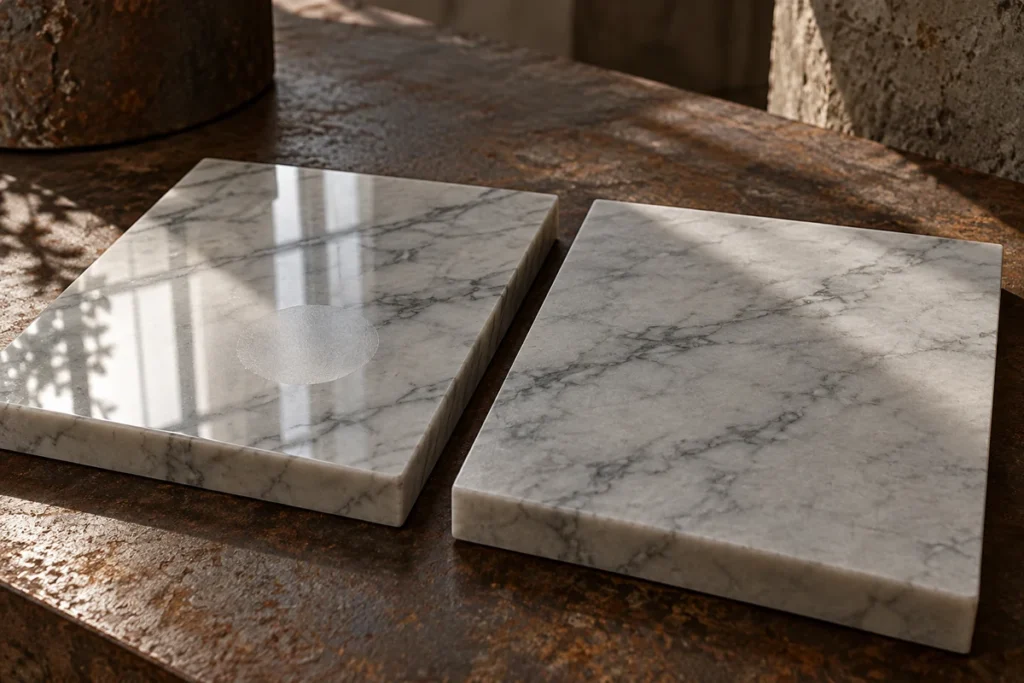
Both are surface finishes on the same natural stone. The difference is how much light the surface returns, which changes how the color, veining, and everyday marks look. Neither finish changes the stone underneath, so both still react to acids. What changes is how much those marks show.
| Consideration | Honed marble | Polished marble |
|---|---|---|
| Surface appearance | Smooth, from matte to a soft satin sheen | Smooth, glossy, and reflective |
| Color and veining | Usually softer and more subdued | Grain and pattern show more strongly |
| Etch visibility | Less noticeable on the low-sheen surface | More noticeable where a dull mark interrupts the gloss |
| Scratch visibility | Fine scratches show less | Fine scratches can stand out against the gloss |
| Staining | Depends on the stone, sealing, and how fast spills are wiped | Depends on the stone, sealing, and how fast spills are wiped |
How the Finish Changes the Look
Honed marble barely shines. That makes it a good partner for strong wood grain or detailed cabinetry, where you want the stone to sit back. It also leaves the sparkle to polished hardware or a statement light. “Honed” covers a range from flat matte to soft satin, so ask your fabricator to show you the exact finish they’ll produce.
Polished marble reflects the room back at you. Use Natural Stone, the Natural Stone Institute’s consumer site, notes that a polished surface shows the stone’s grain and pattern more clearly than a honed one. If the veining is the point, look at the full slab, not a sample. A 3D rendering can then help you plan where the strongest movement lands on an island or wall.
Etching, Stains, and Everyday Care
Marble picks up three kinds of marks, and the finish changes how loudly each one shows:
- Etches are dull spots where acid has reacted with the stone. Lemon juice, tomato sauce, and vinegar are common culprits. Etches stand out most on polished marble.
- Scratches are physical marks from abrasion, and both finishes get them. One restoration specialist notes that etches and scratches show less on honed surfaces, but honing doesn’t make the stone scratch-proof.
- Stains happen when a liquid soaks in. Sealing helps keep stains from going deep, but a sealer does nothing to stop etching.
- The routine is the same for either finish. Ask your supplier whether your marble needs sealing, wipe spills promptly, and clean with mild soap or a product labeled for stone.
Choosing a Finish for Your Space
A countertop takes knives and lemon juice, while a feature wall mostly gets looked at. Pick each surface’s finish for its job.
Kitchen Countertops and Islands
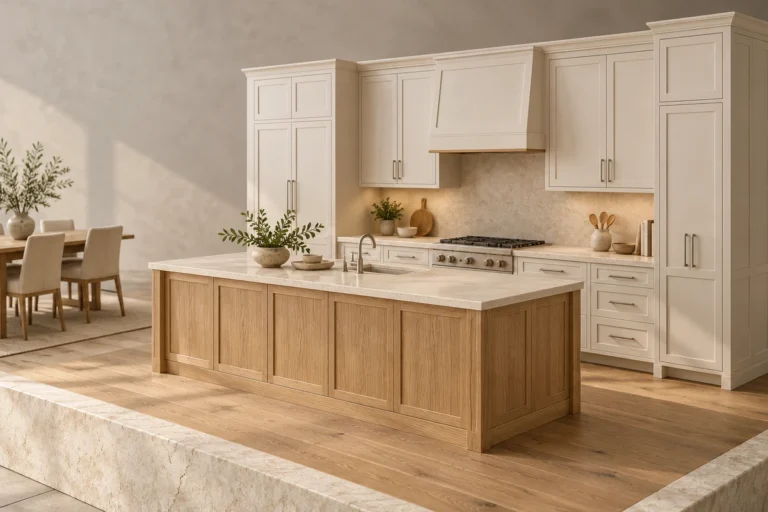
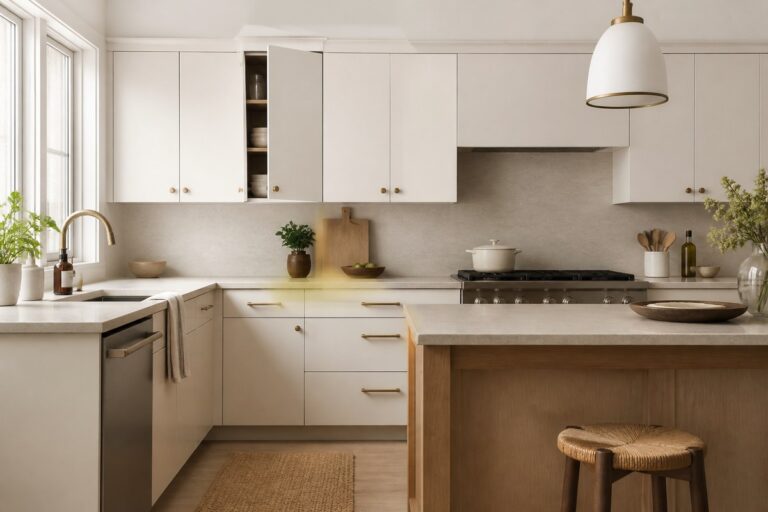
Honed marble suits a busy kitchen if you like a softer surface and can accept some etching. Polished works too, but every mark will catch the light. If any etching at all would bother you, the real question is whether marble belongs on that countertop, not which finish.
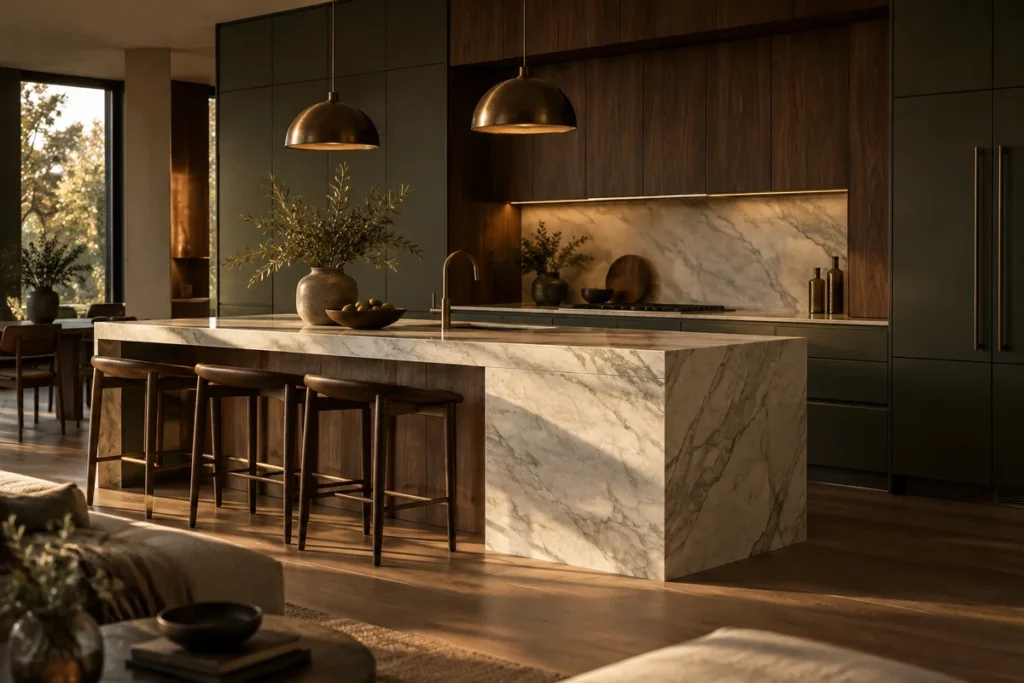
Judge the finish with the cabinet color, backsplash, edge profile, and lighting, the same way you’d weigh any of the countertop materials on your shortlist. Then look at the island from the living area, not only the work side. A reflection that seems subtle up close can stretch across a large top. On a waterfall island, agree with your fabricator how the veining will meet at the top and the end panel.
Bathroom Vanities and Walls
On a double vanity, compare the top with the mirror, fittings, and cabinet fronts. Honed keeps the counter quiet beside strong wood grain or a patterned wall. Polished adds sparkle around the basins. A long vanity can reflect several lights at once, so judge the finish across its full width, and ask your supplier for care guidance suited to the stone.

A feature wall gets touched far less than a countertop, so its finish is mostly a visual call. Polished brings out the veining and bounces light, while honed softens the pattern. Check where fixtures and windows will reflect across the slab before you approve it. Where the marble meets tile, compare its sheen with the bathroom tile planned for the floor and other walls.
Confirming Your Marble Finish
Before you order, confirm the finish on the stone you’re actually buying:
- Compare both finishes on the same marble, ideally from the slab or batch you’re considering, under light similar to the finished room. Clients of GEORGE Design Studio can view samples at our Foshan showroom.
- Check the stone in context. Review it in the rendering with the cabinetry and lighting, from key viewpoints such as the kitchen and the living area beside it.
- Lock the details with your fabricator: slab, finish, edge treatment, and seam locations.
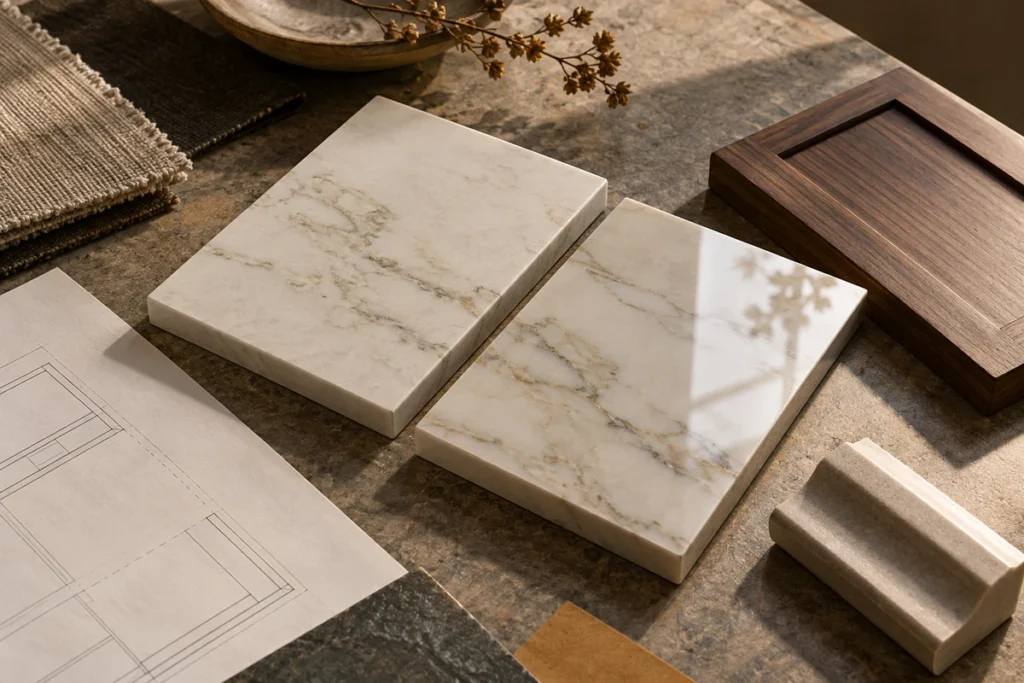
To bring the stone into a wider interior scheme, send us your plans along with the marble you have in mind.
FAQs About Honed and Polished Marble
Is Honed Marble More Expensive Than Polished Marble?
Not necessarily. Get quotes for both finishes on the same marble, covering the slab, any extra finishing, fabrication, and installation. Prices vary by stone and supplier, and comparing two unrelated slabs tells you nothing about the cost of the finish itself.
Can You Change a Marble Finish After Installation?
Possibly, but only a specialist can tell you. Rehoning and repolishing are professional restoration work. Whether your surface can move from one finish to the other depends on the stone, its condition, access, and the details around it. Ask, too, whether fixtures must come off so the stone can be worked around their bases.
Can You Mix Honed and Polished Marble in One Room?
Yes. A honed countertop keeps the work area quiet while a polished feature wall gives the room a reflective focal point. Where the two surfaces meet, check the change in sheen and veining at the joint before approving the layout.
Is Polished Marble Suitable for a Bathroom Floor?
Not without checking the data. In Natural Stone Institute slip-resistance testing, polished finishes did not meet the 0.42 DCOF benchmark, a wet slip-resistance measure, as an average for any stone type. That benchmark applies to level interior floors expected to be walked on when wet, and some individual samples did pass. Ask your supplier for slip-resistance data on the specific stone and finish, and have a local professional confirm it suits the floor.
Source
- Selecting the Ideal Stone Finish, Use Natural Stone: how honed and polished finishes differ in reflection and in how clearly they show grain and pattern.
- What to Expect During a Natural Stone Restoration, Use Natural Stone: etches and scratches showing less on honed surfaces, rehoning and repolishing as restoration work, and working around sink fixtures.
- How to Care for Your Marble Countertops, Use Natural Stone: what etching is, sealers not stopping etching, and daily cleaning with mild soap or a stone cleaner.
- Testing Frictional Properties of Natural Stone Walking Surface, Natural Stone Institute: ANSI A326.3 DCOF testing, the 0.42 benchmark for level interior floors walked on when wet, and results for polished finishes.