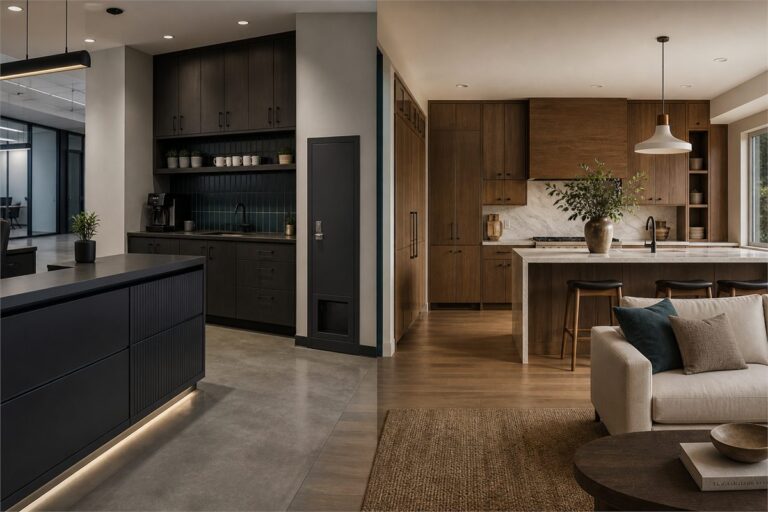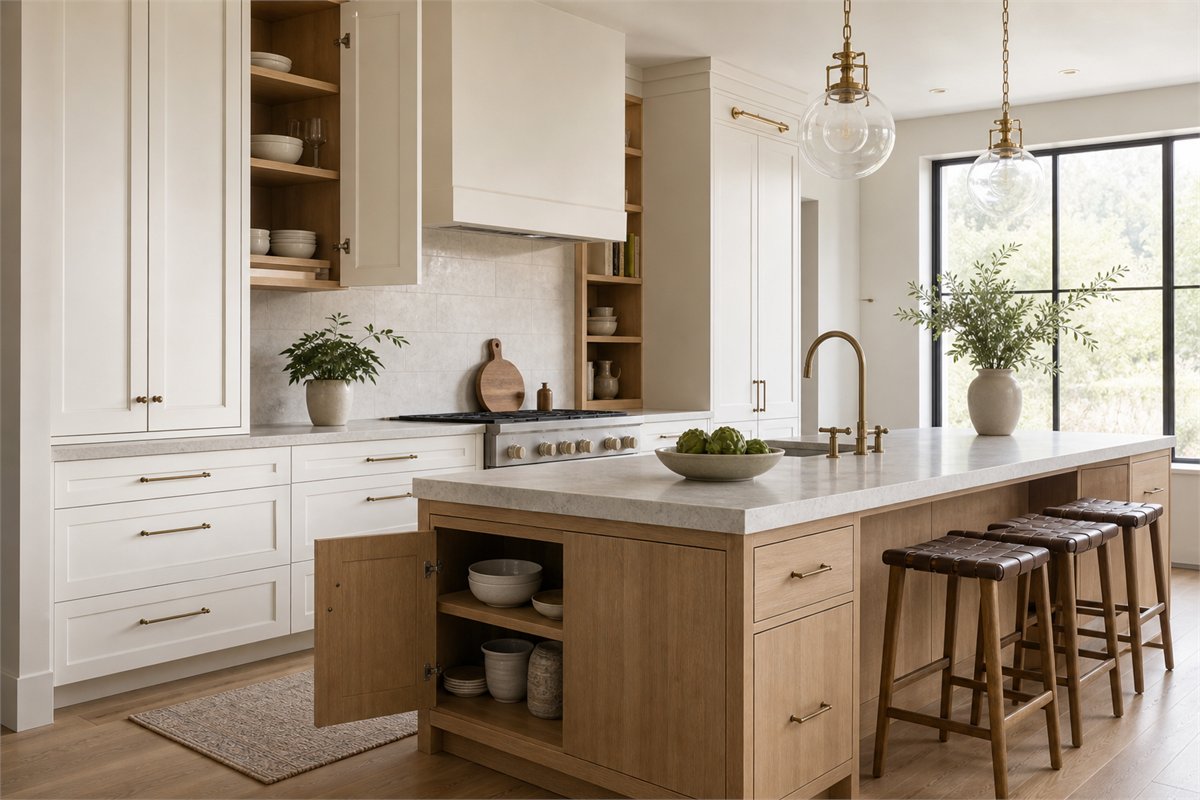
Project teams should specify kitchen cabinet materials by component, exposure, finish system, hardware interface, and approval evidence. Labels such as “plywood cabinets” or “MDF doors” are too broad for pricing, fabrication, substitution review, or inspection. Use a component schedule to record each part’s substrate, thickness, surface, edges, and finish.
What Does a Kitchen Cabinet Material Specification Cover?
A specification covers every visible and concealed part that affects appearance, fit, attachment, cleaning, or service life. Drawings, schedules, and submittals should use consistent names and finish codes.
Within the interior design services scope, name the reviewer for shop drawings, finishes, substitutions, and site conditions.
Cabinet components and material schedule review](https://georgedesignstudio.com/wp-content/uploads/2026/08/kitchen-cabinet-components-specification-review-1024x683.jpg)
Cabinet Boxes, Backs, and Shelves
Specify sides, tops, bottoms, partitions, stretchers, backs, nailers, and shelves separately. For each part, state panel type or species, grade, thickness, face and back treatment, exposed-edge treatment, and applicable load, moisture, or attachment requirements.
A “plywood box” may still contain a hardboard back or engineered-wood shelves. Identify any change that affects load capacity, moisture exposure, attachment, or a visible interior. Wall cabinet drawings should define blocking, fasteners, and the load path because back-panel thickness alone does not establish mounting capacity.
Doors, Drawer Fronts, and Face Frames
Specify doors and drawer fronts independently from the box. Slab fronts, five-piece doors, veneered panels, and solid wood frame-and-panel doors require different cores, joints, edges, and finishes.
State the substrate or species, construction method, profile, face and back finish, grain direction, sheen, and finish code. For face frames, add member dimensions and joint details. The chosen kitchen cabinet style must use a substrate, construction method, and finish system that can reproduce the approved profile consistently.
Drawer Boxes and Interior Components
Define drawer sides, backs, bottoms, dividers, trays, pull-outs, and interior fittings separately. Record the material, thickness, joinery, edge finish, interior coating, and load condition. Coordinate those choices with the slide manufacturer’s clearances, fasteners, and mounting locations. When the outside dimensions stay fixed, thicker sides reduce usable width. A thinner bottom may need a different groove or added support. Review drawer and slide as one assembly.
Exposed Ends, Fillers, and Toe Kicks
Mark exposed, semi-exposed, and concealed surfaces on the elevations and finish schedule. Apply finish codes to end panels, fillers, scribes, valances, toe-kick faces, visible bottoms, and appliance panels.
State whether an exposed end is a finished box side or an applied panel. Define grain direction, veneer matching, edges, joints, and acceptable color variation. At floor level, define the toe-kick substrate and finish, sealed cut edges, cleaning clearance, and removable access panels.
How Do Common Cabinet Construction Materials Compare?
No cabinet material suits every component. Compare products by grade, thickness, bond, density, edges, fastening, and exposure.
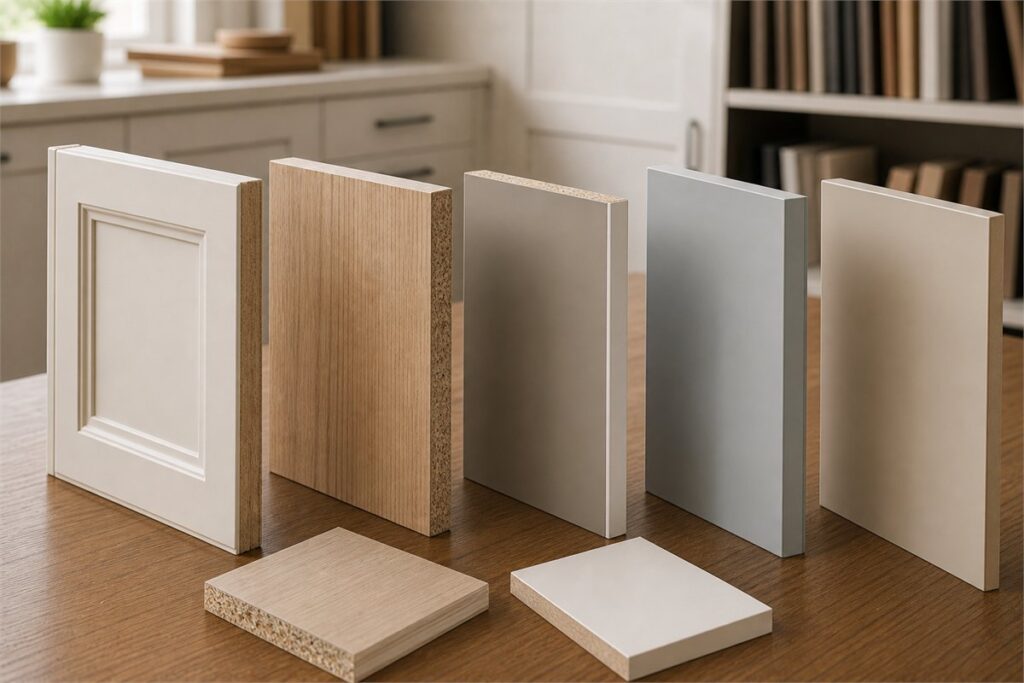
Kitchen cabinet construction material samples](https://georgedesignstudio.com/wp-content/uploads/2026/08/kitchen-cabinet-construction-materials-comparison-1024x683.jpg)
| Material | Common roles | Main specification controls | Conditions to check |
|---|---|---|---|
| Plywood | Boxes, shelves, backs, panels | Standard, veneer grade, core, thickness, bond | Voids, edges, flatness, finish compatibility |
| Medium-density fiberboard | Painted doors, routed fronts, panels | Grade, density, thickness, moisture-resistant designation, coating | Edge fastening, wetting, weight, profile sealing |
| Particleboard | Melamine-faced or laminate-faced boxes and shelves | Grade, density, thickness, surface, edge banding | Fasteners, edge damage, wetting, shelf span |
| Solid wood | Face frames, rails, stiles, trim | Species, grade, cut, moisture content, member size, joints | Wood movement, color variation, distortion |
The USDA Wood Handbook distinguishes plywood, particleboard, and MDF by veneer, particle, or fiber construction. Use grade and manufacturer data to compare products within each panel type.
Plywood
Plywood consists of bonded veneer layers with adjacent grain directions usually crossing. Crossed grain directions help balance stiffness across the panel, but performance still depends on species, veneer grade, core, bond classification, voids, and manufacturing control.
Specify the standard or named product, exposure, face and back grade, core, thickness, and edge condition. Approve visible core edges. For banded edges, define the material, thickness, color, adhesive, and permitted seam. Do not use “marine grade” as shorthand for cabinet quality or assume that marine plywood makes an assembly waterproof.
Medium-Density Fiberboard
Medium-density fiberboard, or MDF, has a uniform surface for paint and routed profiles. Products differ in density, internal bond, thickness swell, machining behavior, and emissions records.
Specify the grade, density or performance class, thickness, moisture-resistant designation when needed, and coating system. Seal cut edges and profiles as required by the coating manufacturer. Moisture-resistant MDF may reduce thickness swell under stated test conditions, but it is not intended for standing water or uncontrolled leaks.
Particleboard
Particleboard provides a flat core for melamine-faced and laminate-faced parts. Performance depends on panel grade, density profile, thickness, joinery, fasteners, surface balance, and edge protection.
Specify the grade, thickness, face system, balancing layer, edge banding, and fastening method. Require a test or mockup for heavy hardware, long shelf spans, or fasteners near an edge. ANSI A208.1-2022 covers particleboard, while ANSI A208.2-2022 covers interior MDF, but panel classification does not establish cabinet performance.
Solid Wood
Solid wood is specified for face frames, door rails and stiles, moldings, shaped profiles, and visible-grain parts. Because wide panels move across the grain as moisture content changes, specify species, grade, cut, member dimensions, grain orientation, joints, finish, and a target moisture-content range for fabrication and installation. Base the range on the service environment, and approve samples that represent expected grain and color variation.
How Do Cabinet Surface Materials and Finish Systems Compare?
The surface system controls color, texture, cleaning limits, edges, and repair options. During material selection and specification, review the surface, substrate, adhesive or coating process, backer, edges, and sample as one assembly.
| Surface system | Typical construction | Useful characteristics | Main specification risks |
|---|---|---|---|
| Paint | Primer and topcoats over an approved substrate | Color and sheen control | Joint telegraphing, edge absorption, incomplete cure, cleaner compatibility |
| Wood veneer | Natural wood face over a panel core | Natural wood appearance on doors and panels | Leaf matching, grain direction, finish shift, panel balance |
| Laminate or melamine-faced panel | Decorative sheet or resin-treated paper over a core | Consistent decorative face, routine cleaning | Chipped edges, seams, unsealed cuts, ambiguous terms |
| Thermofoil, PET, or acrylic | Formed film or bonded sheet over a compatible core | Consistent matte or gloss faces | Heat limits, bond failure, scratches, limited repair |
Paint Systems
Name the substrate, surface preparation, primer, coating type, coat build, sheen, cure requirements, face and back treatment, edge sealing, and touch-up method.
Review the finish on the specified substrate and profile. A color chip cannot show coverage over an MDF edge, routed recess, wood joint, or plywood edge. For a high-use kitchen, check the coating manufacturer’s data for stain resistance, approved cleaners, cure time, and field-repair procedures.
Wood Veneer Systems
Specify the species, cut, leaf match, panel match, grain direction, sequence when required, core, edge treatment, and finish. Veneer matching and grain controls determine whether adjacent doors show a coordinated pattern across the elevation.
Use a larger sample when the wood has strong figure or color variation. Identify the veneer and topcoat because stain, sealer, and sheen affect appearance. Use the panel manufacturer’s required back treatment or balancing construction to reduce distortion risk.
Laminate and Melamine-Faced Panels
High-pressure laminate, compact laminate, and thermally fused laminate are different products. Because suppliers may use “melamine” as a broad label, name the surface type, manufacturer reference, grade, core, backer, and performance data.
State the surface code, texture, sheen, grain direction, edge material and thickness, adhesive, and permitted seams. Review sink bases, dishwasher ends, appliance openings, and shelf edges because flat samples do not show these transitions. Approve cleaning instructions for the assembly.
Thermofoil, PET, and Acrylic Surfaces
Specify thermofoil, polyethylene terephthalate (PET), and acrylic as separate systems. Thermofoil commonly uses a formed film over a shaped core. PET and acrylic may use bonded sheets on flat panels, although construction varies by manufacturer.
Use the supplier’s product data to define the product, core, face and back construction, bonding method, edges, service-temperature limits, cleaning restrictions, and repair method. Review a full door or panel for profile quality, gloss consistency, scratch visibility, and how replacement parts will be matched.
How Should Project Teams Select and Specify Cabinet Materials?
Project teams should map exposure and duty before selecting materials, then record each choice in a component schedule. When one team handles interior design and material supply, assign responsibility for coordinating cabinets with appliances, countertops, flooring, lighting, and site conditions.
Matching Materials to Moisture, Heat, and Cleaning Conditions
Map risk by location. Sink bases, dishwasher ends, beverage stations, trash pull-outs, range-adjacent doors, toe kicks, and cabinets below plumbing do not face the same conditions as wall cabinets in dry locations. For each risk location, confirm:
- Expected splashes, leaks, humidity, heat, steam, grease, and cleaning chemicals
- Required panel grade, sealed edges, finish coverage, liners, pans, or access
- Appliance clearances, ventilation, heat protection, and plumbing access
- Cleaning products and contact times allowed by the surface manufacturer
A moisture-resistant panel cannot correct an unsealed field cut, leak, blocked ventilation path, or standing water. Show these interfaces in the drawings.
Balancing Cost, Maintenance, and Repairability
Compare installed cost and service needs by component. A lower panel price may lose its advantage when the assembly requires complex edge work, restricted cleaners, difficult color matching, or full-door replacement after local damage.
Confirm how each finish will be cleaned, touched up, refinished, replaced, and matched after the production run. Review warranty exclusions for heat, steam, water, chemicals, sunlight, and unapproved cleaners. Assign each material where its appearance, moisture performance, and repair options meet a stated project requirement.
Defining Material Grades, Thicknesses, Edges, and Finish Codes
Create a schedule row for each materially different component.
| Schedule field | Required entry |
|---|---|
| Component and location | Part, cabinet reference, and exposure |
| Substrate or species | Named panel product, panel type, or wood species |
| Standard or grade | Standard, grade, or performance class |
| Nominal thickness | Unit and tolerance |
| Face and back | Surface and balancing treatment |
| Edge system | Material, thickness, adhesive, and joint limits |
| Finish code | Color, stain, sheen, and coating system |
| Required evidence | Product data, sample, compliance record, or test |
Select grades and thicknesses from duty, span, fabrication method, and hardware. When ANSI/AWI 0641-2019 applies to architectural wood casework, require materials and construction methods that comply with its tested, documented, and approved provisions for the specified Performance Duty Level. Name the dimension system. Do not treat 18 mm and 3/4 inch as identical unless the tolerance covers the difference.
Reviewing Samples, Submittals, and Compliance Documents
Before production, review shop drawings, the component schedule, product data, labeled finish and edge samples, hardware data, cleaning instructions, and compliance records. Confirm the compliance basis:
- EPA TSCA Title VI applies to regulated hardwood plywood, MDF, particleboard, and finished goods containing these panels, subject to its definitions and exemptions. Regulated composite wood panels manufactured in or imported into the United States after March 22, 2019 require certification by an EPA-recognized third-party certifier and TSCA Title VI labeling. Finished goods have labeling and recordkeeping duties.
- ANSI/KCMA A161.1-2022 is a performance and construction standard for factory-assembled kitchen and vanity cabinets. It does not prescribe cabinet materials.
If the team reviews finishes in a kitchen showroom, separate current, pending, discontinued, damaged, and archived samples. Label each approval with its item code, location, revision, date, and reviewer.

Managing Material Substitutions and Approvals
Require written approval before changing the substrate, grade, thickness, veneer, surface, adhesive, edge band, coating, attachment method, or compliance basis. A substitution described as “equal” still needs component-level evidence.
Compare the assemblies for appearance, dimensions, tested performance, emissions records, cleaning, repair, warranty, cost, and schedule. Attach data and a sample when appearance or fabrication changes. After approval, update project records and retain the substitute as the control sample.
Frequently Asked Questions
How Can Project Teams Identify Existing Cabinet Materials During a Renovation?
Start at concealed locations such as a hinge bore, shelf-pin hole, panel edge, or plumbing cutout. Alternating veneer plies usually indicate plywood. Uniform fibers suggest MDF, while compressed particles suggest particleboard. Check more than one location because veneer and edge banding can hide the core. If the finding affects structural support, pricing, or reuse, obtain an authorized sample or specialist review. Treat hazardous-material assessment as a separate investigation.
Can Cabinets Made From the Same Material Perform Differently?
Yes. Cabinets with the same material label can perform differently because grade, thickness, joinery, fasteners, finish, hardware, and exposure all affect the assembly. Compare the box, mounting method, test evidence, and warranty. Treat framed and frameless cabinet construction as assembly choices rather than quality grades.
Does Cabinet Material Affect Hinge and Drawer Slide Attachment?
Yes. The substrate and thickness affect pilot holes, fasteners, screw depth, cup boring, mounting plates, drawer clearance, and local breakout. Follow the hardware manufacturer’s instructions for the exact substrate, thickness, fastener, hinge, or slide. If the attachment falls outside the published instructions, obtain written acceptance from the cabinet or hardware manufacturer or require an assembly test. Reserve engineering review for cabinet anchorage or load-bearing support outside supplier documentation.
Do Heavy Countertops Require a Different Cabinet Box Specification?
Not automatically. A heavy countertop needs a verified load path, but the design may use continuous bearing, added rails, reinforced openings, support at seams and overhangs, or separate framing instead of another box material. Confirm weight, spans, cutouts, overhangs, support, anchorage, and installation with the cabinet and countertop suppliers. Seek structural review when the load, span, opening, overhang, or anchorage falls outside their published details.
How Can Project Teams Confirm Delivered Cabinets Match the Approved Material Specification?
Inspect delivered cabinets against approved drawings, schedules, control samples, and submittals before installation hides evidence. Where visible, check product and lot references, panel thicknesses, cores, surface and edge codes, grain direction, hardware mounting, finish match, and compliance labels. Record discrepancies by cabinet and location. If visual checks cannot confirm a structural, moisture-exposed, or regulated part, use traceability records, retained offcuts, or a third-party test. Do not cut or drill a finished cabinet without written approval.