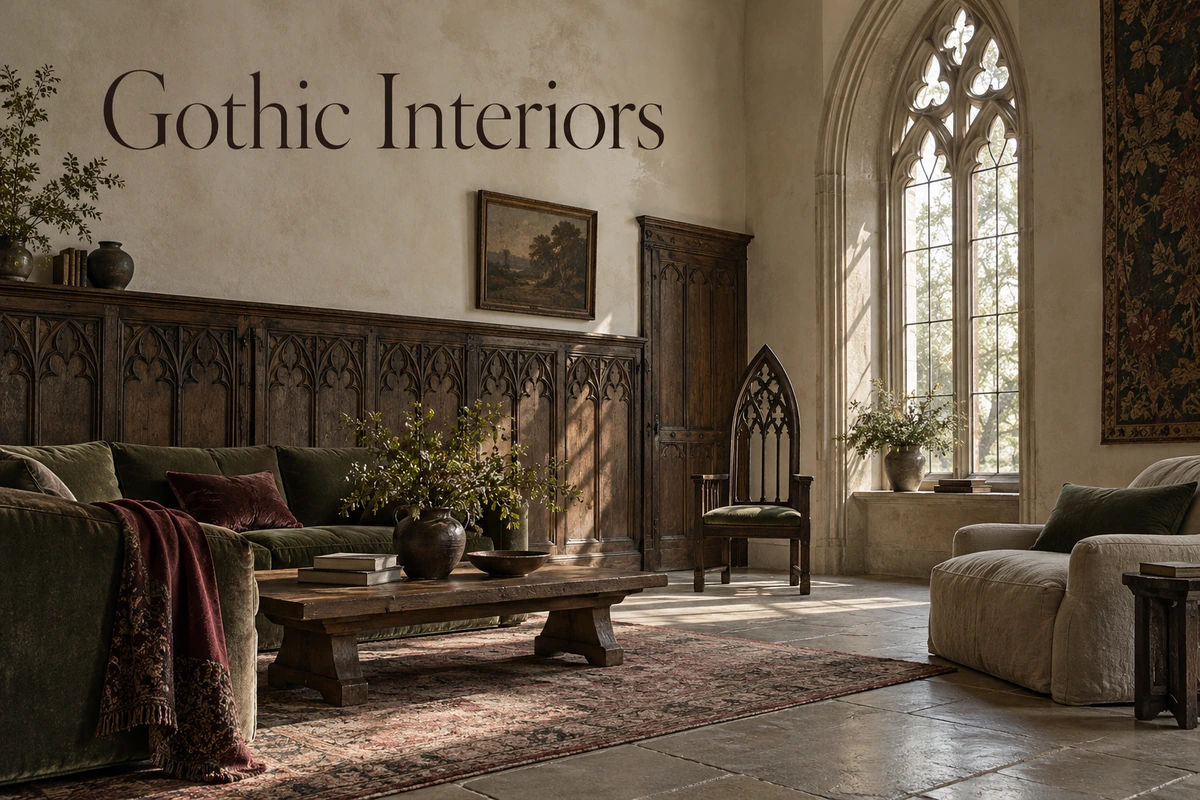
Gothic interior design is built from a short list of features: pointed arches, tracery, carved wood paneling, and furniture whose outline borrows from architecture. A contemporary home usually takes only a few of them, and they hold together when they echo each other. A tall pointed opening sets the room’s vertical line, and a carved chair back can repeat that point at a smaller scale.
When you study a Gothic reference photo, find its tallest shape first, then look for the places where that shape appears again. Write those repeats down; they’re the details a designer can work from.
What Defines Gothic Interior Design?
Gothic interior design applies forms from medieval Gothic architecture, chiefly the pointed arch, tracery, and carved woodwork, to rooms and furniture. You’ll see it at three stages. Medieval buildings supplied the forms, and the Gothic Revival adapted them for houses and furniture. Today’s Gothic-inspired rooms borrow just a few, usually for an otherwise contemporary home.
The National Trust’s article “What is Gothic Revival?” ties the revival’s rise in popularity to eighteenth-century politician Horace Walpole and Strawberry Hill, the Gothic Revival house he created. The article then follows the style into its better-known nineteenth-century work, including Charles Barry and Augustus Pugin’s design for the Houses of Parliament. Keep those periods apart when you read a photo. A modern room painted black can look Gothic at a glance and still contain none of the forms those earlier interiors used.
The Key Features of Gothic Interiors
Five features do most of the work in a Gothic-inspired room: pointed and vertical forms, tracery and paneling, strong furniture outlines, textured materials, and deliberate color and light. The first three come from Gothic architecture. The other two decide how much of that detail you can see.
Vertical Proportions and Pointed Forms
The pointed arch is the quickest way to spot a Gothic reference. In a room, it may frame a doorway or window; in furniture, it may shape the top of a chair back or a mirror. Tall, narrow forms do similar work by pulling your eye upward, even without a point at the top. In a photo of a modern room, look for a mirror, cabinet, or headboard that repeats the height and point of a nearby opening. That repeat is the room’s main Gothic line.
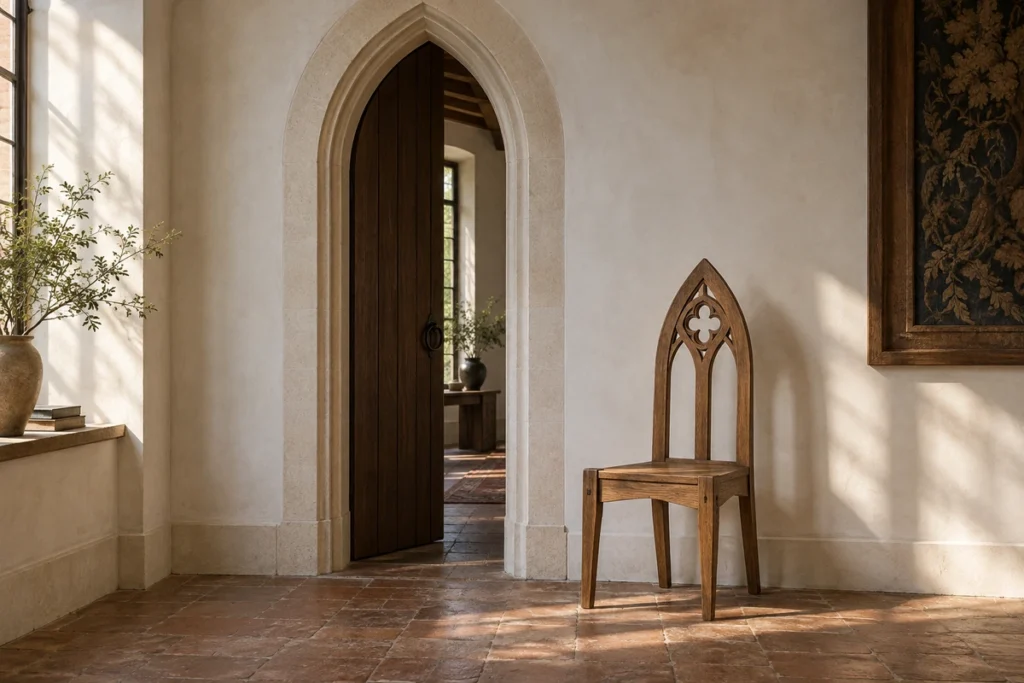
The Metropolitan Museum of Art has a clear example in a mahogany armchair made by John and Joseph W. Meeks in New York around 1850. According to The Met’s record, the back rises to a pointed arch framing a rose-window design. Gothic builders made rose windows in glass; this chair renders one in carved wood. The museum also notes that the spiral-turned legs follow Elizabethan motifs, so even a Gothic Revival chair could mix its sources.
Tracery, Paneling, and Repeated Details
Tracery is the stone framework that divides a Gothic window into smaller openings, often in branching or looping patterns. The same patterns also appear on paneling and furniture. A plain pointed outline and full tracery give two levels of detail. The outline reads from across the room; tracery fills a surface with pattern you notice up close.
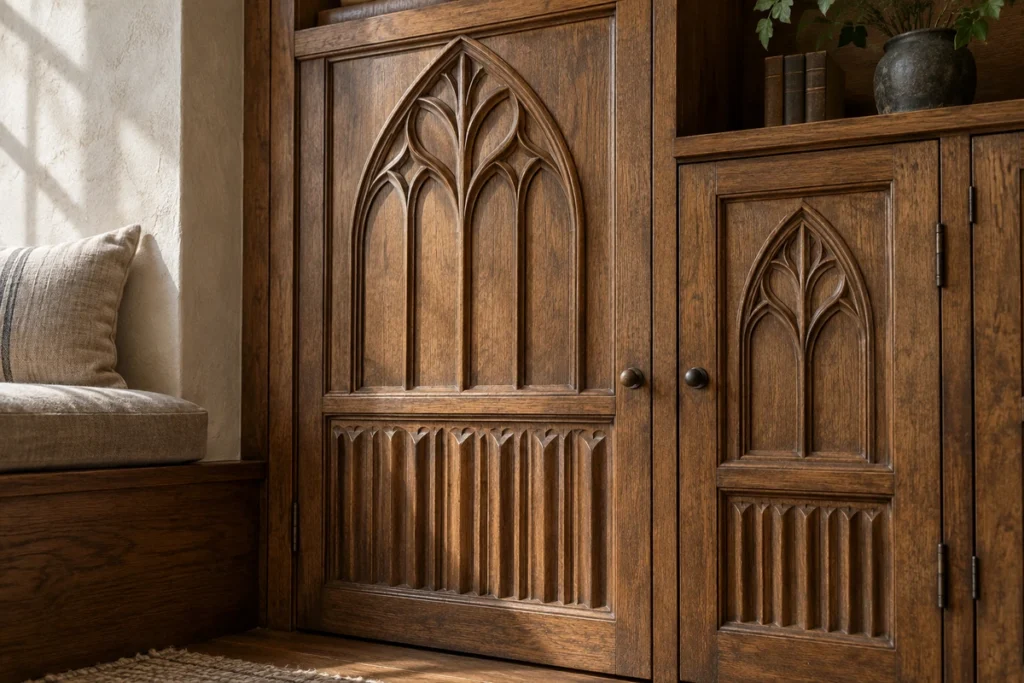
The Met holds carved oak panels from the Palace of Westminster, designed by A.W.N. Pugin and dated about 1845 to 1859. The panels were made for the House of Lords and the House of Commons. The Met describes their patterns as drawn from medieval tracery and linenfold, a carving that imitates folded cloth. They were one part of a larger Pugin interior program that also covered brasswork, stained glass, tiles, and furniture.
In a house today, that idea usually lands in custom joinery: a paneled wall, a run of cabinet doors, or a built-in bookcase. Choose one tracery or panel pattern and let it appear on two or three of those surfaces, instead of giving each surface its own pattern.
Furniture With a Clear Silhouette
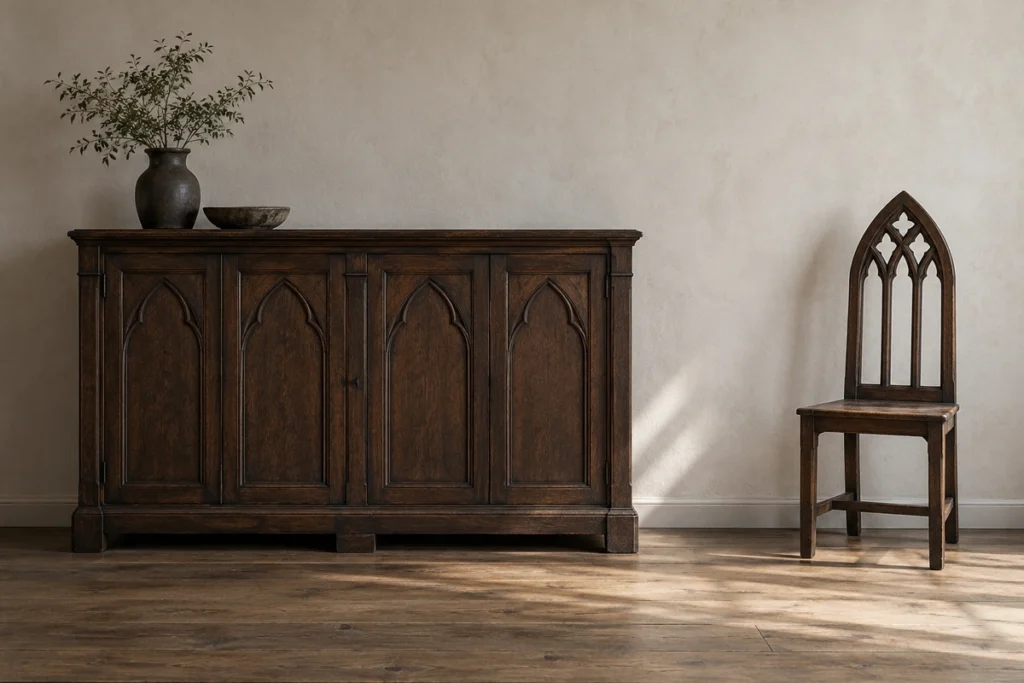
Look at Gothic-influenced furniture as a silhouette first. Squint, or picture the piece in black against a white wall. The back, legs, stretchers, and the gaps between them carry the architectural reference, and the upholstery and finish come second. For each piece, decide what it contributes: its outline, its carving, or both.
Pugin’s oak prayer desk at The Met, from about 1844, shows how little ornament that takes. The museum describes it as rather plain, with no upholstery or padding. Its character comes from the curves of two chamfered uprights and the ogival, arch-shaped edges cut under the elbow-rest crosspiece and the trestle feet. Its purpose was devotional, but its shape shows that Gothic Revival furniture could be quite simple.
Material Texture and Depth
In a Gothic room, a material matters for the surface it makes. Carved oak holds shadow in every recess; a flat oak panel doesn’t. Patterned or colored glass breaks up the light that a clear pane lets straight through. Set a deeply textured surface beside a smooth one and each becomes easier to read.
Then balance where the detail sits. If the woodwork is elaborate, choose plain upholstery so the carving stays visible. If the architecture is simple, let a patterned textile or a strongly shaped chair supply the detail. When you gather samples, compare finish, pattern, and scale side by side, at roughly the size each will appear in the room.
Color and the Treatment of Light
A Gothic-inspired room doesn’t have to be dark. Burgundy, deep green, and charcoal can all work, and so can a pale wall that lets dark carved furniture stand out. Choose the palette by how much contrast you want between the wall, the furniture, and the carved detail.
Light decides what a reference photo lets you see. In a heavily shadowed image, check whether you can still make out the carving, the furniture outlines, and the edges where one surface meets another. If you can’t, the photo is mostly selling a mood, and you’ll need other images to judge the materials and proportions. Tell your designer which version you’re after, too: the room by daylight or the room at night.
Design Principles That Bring the Features Together
A Gothic-inspired room holds together when one feature leads, one motif repeats, and the heavier pieces have space around them.
Establish a Dominant Feature
Notice where your eye lands first. It might be a pointed opening, a fireplace, a carved wall, or one large piece of furniture. That’s the lead, and the pieces near it should defer to it through their position, color, or amount of ornament.
A carved cabinet needs plainer neighbors so its outline stays clear. Under an elaborate ceiling, let the furniture form a quieter layer. Put both decisions in your brief: the feature you want to lead, and the parts you’re happy to keep simple.
Repeat a Motif With Restraint
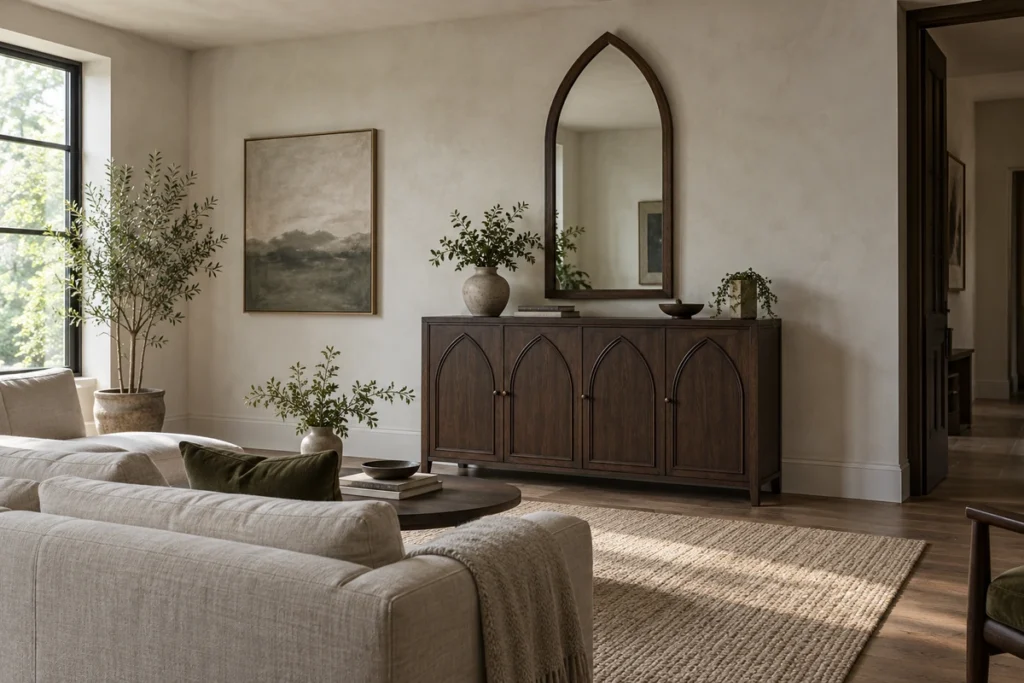
Pick one motif and repeat it at different sizes, such as a pointed profile, a slender vertical, or a single carved pattern. A pointed mirror above a cabinet with simpler pointed door panels is enough to connect the two. Keep the rest of the furniture plain so the shared shape is easy to spot.
When you review an inspiration photo, count the pieces that carry heavy detail. If several are equally elaborate, they’re competing for attention, and the motif gets lost.
Balance Visual Weight With Open Space
Visual weight is how much of the view a piece blocks, and it can differ from the piece’s actual size. A solid cabinet front reads heavy. An open, pierced chair back of similar height lets the wall show through.
Around a large table or dark upholstered seating, leave some wall and floor visible so each outline can be read. In a crowded inspiration photo, ask yourself whether you like each piece or just how densely the room is packed.
Reading Gothic Design in a Modern Home
A modern residential interior can carry two or three clear Gothic references and keep everything else simple. Picture a living room with a plain ceiling. An oak cabinet with pointed door panels stands against one wall, a tall mirror with a pointed top hangs above it, and a low upholstered sofa faces them. The cabinet carries the architectural detail, the mirror continues its vertical line, and the plain sofa leaves both easy to see. The point appears twice, at two sizes, and nothing else in the room competes with it.
Most Gothic reference photos mix a feature you want with a setting you don’t. You might love the rhythm of the paneling without wanting it on every wall, or like an antique chair’s outline without the collection around it. Your own house sets limits too. If it has original millwork, a fireplace surround, or period doors, decide what to keep and what to update before you add Gothic pieces.
From Reference Images to a Clear Design Direction
Mark up each reference image before you share it. Circle what you want to keep, such as the height of an opening, the scale of a chair, a carved pattern, or the way wood meets fabric. Cross out what you don’t want. A photo can show the right style with a layout or amount of decoration that wouldn’t suit your house, and those cross-outs are useful information too.
At GEORGE Design Studio, we turn style references like these into residential concepts, working out the layout, architectural details, furniture, and material direction together. Our 3D views let you check the height of a feature wall, the scale of a cabinet, or a finish beside the furniture before you approve the direction.
When you’re ready to talk through a direction for your home, start a project conversation and bring your floor plan, current photos, and marked-up references.
FAQ
Is Antique Furniture Necessary for Gothic Interior Design?
No. New pieces, furniture you already own, or a mix can all work if their shape, scale, and detail suit the room. If a seller calls a piece an authentic period antique, ask for evidence of its age and origin, since a Gothic look doesn’t establish either.
Can Gothic Design Work With Low Ceilings?
Yes, if you keep the Gothic references at furniture scale. A slim pointed mirror or a cabinet with patterned door panels carries the idea without a large overhead feature. Check proportions in a 3D view of your own room. A photo of a much taller interior won’t show how the same piece sits under a lower ceiling.
Does Gothic Interior Design Require Religious Imagery?
No. Pointed arches, tracery, and carved paneling work without any religious imagery. Some historical pieces did have a devotional purpose: Pugin designed his prayer desk for the chapel in his own house, The Grange, in Ramsgate. That history doesn’t carry over to your room, so treat any symbols in a reference image as a separate choice from its shapes and materials.